Apotheosis of HerculesApotheosis of Hercules(Apothéose d'Hercule)Apotheosis of Hercules
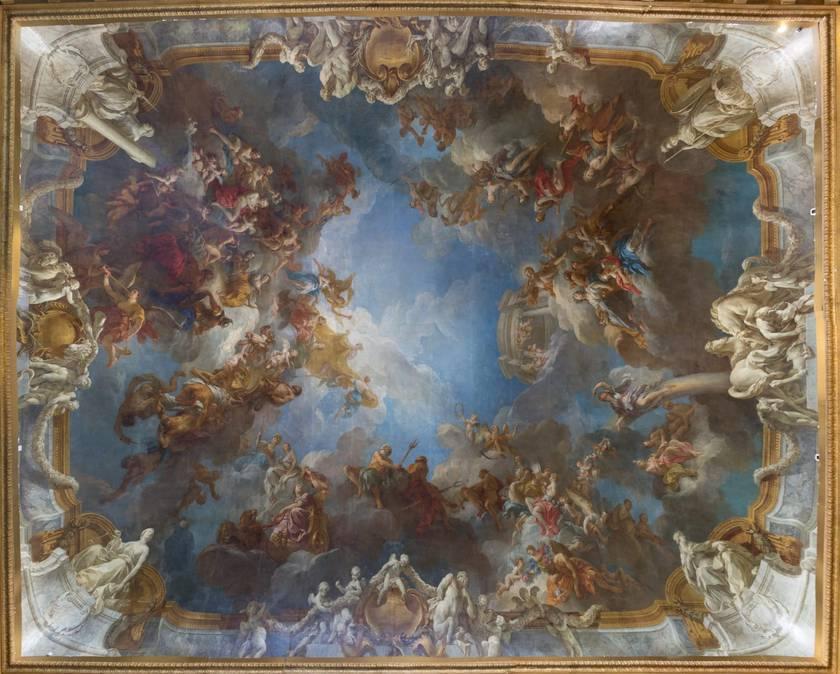
In , King Louis XV (opens in a new tab) inaugurated at the Palais de Versailles the work of the painter François LEMOYNE (opens in a new tab), newly created for the Salon of Hercules (opens in a new tab), “The Apotheosis of Hercules” and reproduced above.
On this occasion, the gazette “Le Mercure de France (opens in a new tab)” published an exceptional text because probably written by the painter himself which tells us about the conditions that presided over this work and also of the detail of its composition.
It is this text that is reproduced below.
This painter's work is exceptional for many reasons and especially to be one of his last.
Indeed, the artist decided to put an end to his days shortly after achieving it, by suiciding of several strokes of sword, in his apartment in Paris on .
Ceiling of a Salon of the Château de Versailles, preceding that of the Chapel of the King, called the Grand Salon de Marbre.
For more than two years we have been working at “Le Mercure de France”, we have always had special attention to celebrate Fine Arts;
but we have never had such a wonderful opportunity that the one that is presenting today, And we thought we did nothing for their glory, if we were negligent in talking about the great book of oil painting that has just been discovered to the eyes of the public;
an exceptional event, which is to most illustrate our School in this century, and serve as a Monument to Posterity, to prove the progress of Painting in France, under the reign of Louis XV.
“The Apotheosis of Hercules” makes the Subject of this immense and beautiful composition.
François Le Moine, from Paris, Professor of the Royal Academy of Painting and Sculpture, Student of Mr. Galoche, Professor of the same Academy, worked in the order of the King for four years, under the direction of the Duke of Antin, Pair of France, Chevalier of His Majesty's Orders, Governor of the Orléanais, Minister of State, and Director General of the King's Buildings, enlightened Protector of the Arts, and always attentive to what can contribute to their advancement.
Wednesday, , the day for the appearance of this great Work, the Salon was, until the time the King crossed it to go to Mass;
Her Majesty accompanied by the Lords, Cardinal of Fleury and other Ministers, followed by a large crowd came from afar;
stopped there for a long time, and more on the return of Mass; The King examined in detail the order in general, the differens groups in particular, the Drawing, the colours the wonderful effect of the whole.
Her Majesty whose delicacy of taste is known, and his love for Painting and for all Fine Arts, after having extremely praised the genius and beauty of Mr Le Moine, appointed him immediately his First Painter, with applause from the entire Court, and an infinite number of spectators whom curiosity had attracted to Versailles, whose contribution does not diminish, it even increases every day to the same degree of the point, which is to be seen of such a well execution of such a great composition;
because to say it, the biggest part of the great Gallery, painted by the illustrious Le Brun, is not almost so big that half the one that gives occasion to this Article.
Ceiling of a Salon of the Château de Versailles
Below the description of it.
This ceiling is 64 feet long, out of 4 wide, and eight and a half feet of indentation area from corniche to top.
The Figures in the attica have ten to eleven feet of proportion;
One can count in the entire Work up to 142 Figures, included about thirty, feigned stuccos.
One can see 62 at a glance by discovering the main Group.
The whole Work rolls on this thought:
The Love of Virtue elevates man above himself and makes him superior to the most difficult and perilous work; the obstacles vanish in the view of the interests of his King and his Fatherland, supported by honour and driven by loyalty, he reaches by his actions to immortality.
“The Apotheosis of Hercules” appears well suited to develop this thought: This Hero was busy during his life only to immortalize himself through virtuous and heroic actions;
and Jupiter of which he had been the image on earth, crown his work in Heaven by immortality.

“Hercules presented to Jupiter by the Love of Virtue”
This is the general idea of the subject.
Hercules presented to Jupiter by the Love of Virtue, is pulled in a Chariot by the Geniuses of the same Love.
Monsters and Vices tamed by the value of this Hero, cannot support his glory are overthrown and rush by making unnecessary efforts to bring it to bear.
Jupiter introduces him to Hebe, Goddess of Youth, led by the Hymen.

“the nine Sisters to celebrate the high feats, and the apotheosis of”Hercules
On the opposite side is Apollo, which invites the nine Sisters to celebrate the high feats, and the Apotheosis of the new God.
Behind Apollo is the Temple of Memory.
Above the Corniche, reigns around an Attica that encircles the Subject, it is drawn up in the middle of enhanced Golden Cartels, accompanied by the main works of Hercules feigned of Sculpture of white marble.
In the corners of the Attica, are four Virtues on Pedestals and feigned the same way.
These Virtues are Force, Your Constancy, Value, Justice, which specifically refers to the character of Hercules.
For the rest, the composition is distributed in nine Groups.

“Under a Curtain supported by the Satellites of Jupiter”
In the first, under a Curtain supported by the Satellites of Jupiter, this God on a throne is intend him for spouse;
Juno who crossed Hercules during her life, seems to approve this change, ingenious figure that proves that the Virtue always overcomes Jealousy and Envy.
at the feet of Jupiter, one sees the Eagle repository of lightning;
Ganymede is next to Hebe, looks with pleasure at the happiness of this Goddess.
Here is the description
Below the description of it.
This ceiling is 64 feet long, out of 4 wide, and eight and a half feet of indentation area from corniche to top.
The Figures in the attica have ten to eleven feet of proportion;
One can count in the entire Work up to 142 Figures, included about thirty, feigned stuccos.
One can see 62 at a glance by discovering the main Group.
The whole Work rolls on this thought:
The Love of Virtue elevates man above himself and makes him superior to the most difficult and perilous work; the obstacles vanish in the view of the interests of his King and his Fatherland, supported by honour and driven by loyalty, he reaches by his actions to immortality.
“The Apotheosis of Hercules” appears well suited to develop this thought: This Hero was busy during his life only to immortalize himself through virtuous and heroic actions;
and Jupiter of which he had been the image on earth, crown his work in Heaven by immortality.
“Hercules presented to Jupiter by the Love of Virtue”
This is the general idea of the subject.
Hercules presented to Jupiter by the Love of Virtue, is pulled in a Chariot by the Geniuses of the same Love.
Monsters and Vices tamed by the value of this Hero, cannot support his glory are overthrown and rush by making unnecessary efforts to bring it to bear.
Jupiter introduces him to Hebe, Goddess of Youth, led by the Hymen.
“the nine Sisters to celebrate the high feats, and the apotheosis of”Hercules
On the opposite side is Apollo, which invites the nine Sisters to celebrate the high feats, and the Apotheosis of the new God.
Behind Apollo is the Temple of Memory.
Above the Corniche, reigns around an Attica that encircles the Subject, it is drawn up in the middle of enhanced Golden Cartels, accompanied by the main works of Hercules feigned of Sculpture of white marble.
In the corners of the Attica, are four Virtues on Pedestals and feigned the same way.
These Virtues are Force, Your Constancy, Value, Justice, which specifically refers to the character of Hercules.
For the rest, the composition is distributed in nine Groups.
“Under a Curtain supported by the Satellites of Jupiter”
In the first, under a Curtain supported by the Satellites of Jupiter, this God on a throne is intend him for spouse;
Juno who crossed Hercules during her life, seems to approve this change, ingenious figure that proves that the Virtue always overcomes Jealousy and Envy.
at the feet of Jupiter, one sees the Eagle repository of lightning;
Ganymede is next to Hebe, looks with pleasure at the happiness of this Goddess.
Second group

“looking with a clever eye and contemptuous of the Love of Virtue”
2nd Group.
On the right of Jupiter, Bacchus seated and leaned on God Pan, consider contentedly the triumph of Hercules.
Bacchus is accompanied by two Sylvains, one of whom ties his Thyrse, and the other some grapes, above appears Amphitrite, and Mercury the Messenger of the Gods ready to execute Jupiter orders.
Below Bacchus one sees Venus with the Three Graces, They are applauding themselves for contributing to make Hebe amiable;
one of the Graces holds a Crown that she seems to intend to him, Cupid who is next to his mother, looking with a clever eye and contemptuous of the Love of Virtue.
At the feet of Bacchus, and a little bit down, Pandora and Diana seem to invite Comus, the Banquets God, to get ready for the Feast: This God wears a pike surrounded by a swag of flowers.

“Mars watching the fall of Monsters and Vices”
3rd Group.
Below Pandore and Diane, and on the front of the Group, one sees Mars watching the fall of Monsters and Vices, that only Virtue, and not Force, strucks down at this time. Vulcan, whose works are devoted to this God, is next to him;
Several Loves on the right of these Deities, and hold Precious Weapons, for the sake of the value of Hercules.
Lower, Two Fames go down to announce the Earth what happens in Heaven in favour of Hercules.

“are precipitated from Heaven”
4th Group.
At the bottom of the Hercules, Envy, Anger, Hatred, Discord and other Vices, of whom the new God triumphed, are precipitated from Heaven, Envy alone is still the closest to the Hero, She threatens him, and her fury seems to give it up only reluctantly, to make known that this Monster is the most dangerous and fierce of all vices, and the only one whose rage extends beyond death.
Fifth group

“looks with joy”, Pluto
“appears to be diverting his looks”
5th Group.
On the front and behind the Chariot of Hercules, Cibele is in his finish by creneaux and dragged by Lions;
A playing Love relieves her of the weight of her Crown.
Above in a depressed plane, one sees Minerva and Ceres with their personal attributes, Neptune and Pluto are next to Cibele;
the God of the Sea looks with joy at the glory of the new God, and Pluto, whose this Hero braved the Empire, appears to be diverting his looks, do not applause to his triumph.

“play with a swag”
6th Group.
One sees Aeolus, God of the Winds;
beside him are Zephyrus and Flora, accompanied by the Air Geniuses;
these tender deities whose sighs create the Flowers, play with a swag formed and matched by the Loves.
Dew is on the front, she leans her Urn over the clouds where are the Nymphs of rain;
below Morpheus is sleeping, Dreams, whose flap are formed by clouds, spread poppies on him.
Above Aeolus, and in remoteness we see the Genius of Eternity, holding his symbol represented by a Serpent in circle, He shows it to Saturn and seems to insult his Scythe, which can nothing with Virtue.

“Iris appears on her Arc”
7th Group.
Going straight towards the Angle, Iris appears on her Arc, she throws a look on the heavenly Feast;
under the Rainbow appears the Dawn with several personified Stars.
On the upper part of the eighth group

“would undertake to execute the Concert ordered by Apollo”
On the top of the 8th group,
one can see the Temple of Memory opened;
several Geniuses are quick to attach Medallions to the memory of Great Men;
Next, Apollo rises on a Cloud with the Genius of Fine arts.
The Muses are below, they would undertake to execute the Concert ordered by Apollo;
in the angle close to the Muses, History exhorts Painting to immortalize like she does, the Heroes and their great Actions.

“Silenus with a troupe of Fauns and Infants, form a Bacchic Feast”
9th Group.
On the left and above the Muses, appears the Constellation de Castor and Pollux.
In the half tint, Silenus with a troupe of Fauns and Infants, form a Bacchic Feast.
The Cartels, whose the middles of the corniche are displayed with, represent the work of Hercules;

“Cerberus”and of the Lion of Nemea
In the first, above the Chimney, one sees on one side Cerberus with his three heads, and on the other the skin of Lion of the Nemea Forest, with the mace, etc.
At the second Cartel

“the Centaur Nessus”
In the Second Cartel, apart from the Boar that Hercules brought alive to Euristheus,
One sees the Harpies and the Golden Apples of the Hesperides, on the other side is the Centaur Nessus, etc.

“eaten by his own Horses”
On the opposite side of the first Cartel, Diomedes eaten by his own Horses, which he fed with human flesh.

“Mascot to the Golden Horns”and Cacus
The third Cartel represents on one side the Mascot to the Golden Horns, with the Horn of Abundance, and the other Cacus suffocated by Alcide.
All these Cartels are crowned by a big swap of oak leaves, supported by the Geniuses of Virtue.
This Swap, feigned of stucco, also-although the figures that surround the Cartels and Virtues, which characterize the actions of Hercules, reigns all along the perimeter of Attica, which is feigned of white marble, veined with purple brèche panels; (geology term. Black marble, mixed with white and yellow spots, derived from the Pyrenees and other places)
the coronation of hte attica is enhanced by gold, all being hold by the Corniche of the Salon.
This corniche is laying on twenty pilasters pairs of the most beautiful marbles, of the four most famous quarries of the Kingdom, with an exquisite choice;
namely, some marble called Dantin, some Vercampan, some Rancé and some white veined, whose bases and capitals are gilded, as well as the corniche and Door Jambs, etc.
The brilliance of this guilding and of that marble, which combines itself and gives to itself, so to speak, a mutual help, makes an so amazing than wonderful effect, and appear to be a trophy to painting, to which they serve as a ornement.
Two famous Paintings by PAUL VERONESE
Two famous paintings by PAOLO VERONESE occupy the two main places of this exhibition;
François Le Moyne, could not have a more worthy and more famous competitor.
The first of these Paintings, 52 feet wide, per 15 high, represents the Feast at the Pharisian's home.
It is placed on the chimney, and the other of 11 feet high, 8 feet wide, occupies the top of the chimney.
It represents Eliezer who asks Rebecca in marriage, etc. The edge of this Painting inlaid in marble is supported by two consoles, all being guilded of melted gold, as well as all the other Ornements of the Chimney, whose middle is marked by a head of Hercules, headed by a muzzle of Lion, accompanied by two large sheets of ornements;
with two horns of abundance completed at the bottom of the Doorframe by two heads or remains of Lion.
This Work is the late Antoine Vassé, a gifted sculptor from Toulon.
The border, of the big painting of Paolo Veronese, inlaid into marble and hold by four consoles, as guilded as melted gold, is from the same sculptor.
The border of the Painting of the Chimney, the andirons, etc. are M. Verbrec, Academy Sculptor.
This is the most accurate and methodical detail we can make, to give an idea of the whole Work to those who are not in a position to see it.
About the relation between the parties to the whole all together, we cannot supplement it through narration, no more than what respect to intelligence, finesse and the sublime of Art, etc,
so far we can ensure that everything has been contribute unanimously to the glory of the Work and the Author, but it is to the fair and enlightened public to judge the sovereign success in general and in the parties where there could still be something to be desired.
We cannot, however, refuse, emboldened and guided by the sight and the memory of this tedious and laborious work, to praise, with the entire public, the beautiful forms, the brilliant and the tender of the colours, the regularity of the well-fetched subjects, the fine characters, the exact observation of the Costume and conventions, because nothing is neglected, and everything is finished as in a easel painting, not to mention so many sharp and real things that strike and surprise the Viewer;
such as some of the cloud groups which crosses the figures and make the effect of accidents of unexpected cases, that characterizes the imitation and makes it admired by Scholars and ignorants.
An observation that many people have made and by which we end this Article, It's that by standing on the side of the Salon, on the side of the Chapel, where one sees the two Ceilings, knowing, that the one of the Living room, which serves as Vestibule to the Chapel, which is not painted, and the one where we represented “the Apotheosis of Hercules”, whose Description has just been read, and which are at the same height, one sees at a glance, against common opinion, that the one which is painted, seems much higher than the one that is not, and where one only sees white.
We believe that this oposition and contrast that one can observe here very conveniently in two adjoining salons and high to an equal height deserves special attention from the Connoisseurs.