Arachne
at the Grand Trianon in the Park of the Palace of Versailles
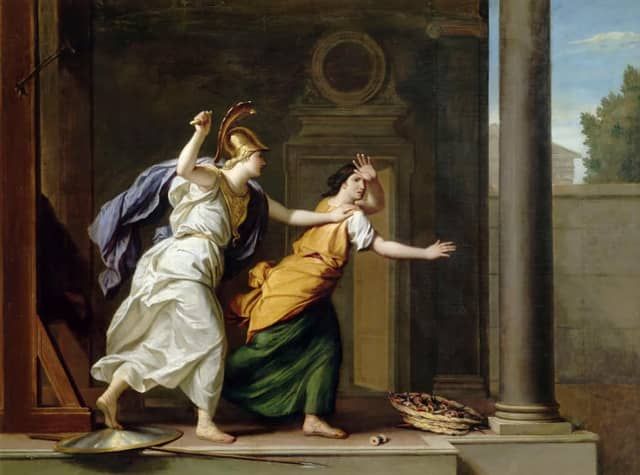
“with her boxwood shuttle in her hand, struck the unhappy mortal on her head,—struck sharply thrice, and even once again, ”“
“The Metamorphoses””
“, Book VI, verses 130.”
At the Grand Trianon (opens in a new tab), in the Salon des Seigneurs, is a painting painted by René-Antoine HOUASSE (opens in a new tab), “Minerva and Arachne”.
It tells the beating of Arachne (opens in a new tab), woman of Meonia that refused to loose against Minerva (opens in a new tab), here goddess of weaving, as Ovid (opens in a new tab) tells in Book VI of the Metamorphosis (opens in a new tab).
Below is the referencing text.
Arachne according to “The Metamorphoses”
1 All this Minerva heard; and she approved
their songs and their resentment; but her heart
was brooding thus,
“It is an easy thing
to praise another, I should do as they:
no creature of the earth should ever slight
the majesty that dwells in me,—without
just retribution.”
—So her thought was turned
upon the fortune of Arachne — proud,
who would not ever yield to her the praise
won by the art of deftly weaving wool,
a girl who had not fame for place of birth,
nor fame for birth, but only fame for skill!
For it was well known that her father dwelt
in Colophon; where, at his humble trade,
he dyed in Phocean purples, fleecy wool.
Her mother, also of the lower class,
had died. Arachne in a mountain town
by skill had grown so famous in the Land
of Lydia, that unnumbered curious nymphs
eager to witness her dexterity,
deserted the lush vineyards of Timolus;
or even left the cool and flowing streams
of bright Pactolus, to admire the cloth,
or to observe her deftly spinning wool.
So graceful was her motion then,—if she
was twisting the coarse wool in little balls,
or if she teased it with her finger-tips,
or if she softened the fine fleece, drawn forth
in misty films, or if she twirled the smooth
round spindle with her energetic thumb,
or if with needle she embroidered cloth;—
in all her motions one might well perceive
how much Minerva had instructed her:
but this she ever would deny, displeased
“Let her contend
in art with me; and if her skill prevails,
I then will forfeit all!”
Minerva heard,
and came to her, disguised with long grey hair,
and with a staff to steady her weak limbs.
She seemed a feeble woman, very old,
“Old age is not
the cause of every ill; experience comes
with lengthened years; and, therefore, you should not
despise my words. It is no harm in you
to long for praise of mortals, when
your nimble hands are spinning the soft wool,—
but you should not deny Minerva's art—
and you should pray that she may pardon you,
for she will grant you pardon if you ask.”
Arachne, scowling with an evil face.
Looked at the goddess, as she dropped her thread.
She hardly could restrain her threatening hand,
and, trembling in her anger, she replied
to you, disguised Minerva:
“Silly fool,—
worn out and witless in your palsied age,
a great age is your great misfortune!— Let
your daughter and your son's wife—if the Gods
have blessed you—let them profit by your words;
within myself, my knowledge is contained
sufficient; you need not believe that your
advice does any good; for I am quite
unchanged in my opinion. Get you gone,—
advise your goddess to come here herself,
and not avoid the contest!”
Instantly,
the goddess said,
“Minerva comes to you!”
And with those brief words, put aside the shape
of the old woman, and revealed herself,
Minerva, goddess.
All the other Nymphs
and matrons of Mygdonia worshiped her;
but not Arachne, who defiant stood;—
although at first she flushed up—then went pale—
then blushed again, reluctant.—So, at first,
the sky suffuses, as Aurora moves,
and, quickly when the glorious sun comes up,
pales into white.
She even rushed upon
her own destruction, for she would not give
from her desire to gain the victory.
Nor did the daughter of almighty Jove
decline: disdaining to delay with words,
she hesitated not.
And both, at once,
selected their positions, stretched their webs
with finest warp, and separated warp with sley.
The woof was next inserted in the web
by means of the sharp shuttles, which
their nimble fingers pushed along, so drawn
within the warp, and so the teeth notched in
the moving sley might strike them.—Both, in haste,
girded their garments to their breasts and moved
their skilful arms, beguiling their fatigue
in eager action.
Myriad tints appeared
besides the Tyrian purple—royal dye,
extracted in brass vessels.—As the bow,
that spans new glory in the curving sky,
its glittering rays reflected in the rain,
spreads out a multitude of blended tints,
in scintillating beauty to the sight
of all who gaze upon it; — so the threads,
inwoven, mingled in a thousand tints,
harmonious and contrasting; shot with gold:
and there, depicted in those shining webs,
were shown the histories of ancient days:—
Minerva worked the Athenian Hill of Mars,
where ancient Cecrops built his citadel,
and showed the old contention for the name
it should be given.—Twelve celestial Gods
surrounded Jupiter, on lofty thrones;
and all their features were so nicely drawn,
that each could be distinguished.—Jupiter
appeared as monarch of those judging Gods.
There Neptune, guardian of the sea, was shown
contending with Minerva. As he struck
the Rock with his long trident, a wild horse
sprang forth which he bequeathed to man. He claimed
his right to name the city for that gift.
And then she wove a portrait of herself,
bearing a shield, and in her hand a lance,
sharp-pointed, and a helmet on her head—
her breast well-guarded by her Aegis: there
she struck her spear into the fertile earth,
from which a branch of olive seemed to sprout,
pale with new clustered fruits.—And those twelve Gods,
appeared to judge, that olive as a gift
surpassed the horse which Neptune gave to man.
And, so Arachne, rival of her fame,
might learn the folly of her mad attempt,
from the great deeds of ancient histories,
and what award presumption must expect,
Minerva wove four corners with life scenes
of contest, brightly colored, but of size
86 diminutive.
In one of these was shown
the snow-clad mountains, Rhodope,
and Haemus, which for punishment were changed
from human beings to those rigid forms,
when they aspired to rival the high Gods.
And in another corner she described
that Pygmy, whom the angry Juno changed
from queen-ship to a crane; because she thought
herself an equal of the living Gods,
she was commanded to wage cruel wars
upon her former subjects. In the third,
she wove the story of Antigone,
who dared compare herself to Juno, queen
of Jupiter, and showed her as she was
transformed into a silly chattering stork,
that praised her beauty, with her ugly beak.—
Despite the powers of Ilion and her sire
Laomedon, her shoulders fledged white wings.
And so, the third part finished, there was left
one corner, where Minerva deftly worked
the story of the father, Cinyras;—
as he was weeping on the temple steps,
which once had been his daughter's living limbs.
And she adorned the border with designs
of peaceful olive—her devoted tree—
which having shown, she made an end of work.
Arachne, of Maeonia, wove, at first
the story of Europa, as the bull
deceived her, and so perfect was her art,
it seemed a real bull in real waves.
Europa seemed to look back towards the land
which she had left; and call in her alarm
to her companions—and as if she feared
the touch of dashing waters, to draw up
her timid feet, while she was sitting on
the bull's back.
And she wove Asteria seized
by the assaulting eagle; and beneath the swan's
white wings showed Leda lying by the stream:
and showed Jove dancing as a Satyr, when
he sought the beautiful Antiope,
to whom was given twins; and how he seemed
Amphitryon when he deceived Alcmena;
and how he courted lovely Danae
luring her as a gleaming shower of gold;
and poor Aegina, hidden in his flame,
jove as a shepherd with Mnemosyne;
and beautiful Proserpina, involved
by him, apparent as a spotted snake.
And in her web, Arachne wove the scenes
of Neptune:—who was shown first as a bull,
when he was deep in love with virgin Arne
then as Enipeus when the giant twins,
Aloidae, were begot; and as the ram
that gambolled with Bisaltis; as a horse
loved by the fruitful Ceres, golden haired,
all-bounteous mother of the yellow grain;
and as the bird that hovered round snake-haired
Medusa, mother of the winged horse;
and as the dolphin, sporting with the Nymph,
Melantho.—All of these were woven true
to life, in proper shades.
And there she showed
Apollo, when disguised in various forms:
as when he seemed a rustic; and as when
he wore hawk-wings, and then the tawny skin
of a great lion; and once more when he
deluded Isse, as a shepherd lad.
And there was Bacchus, when he was disguised
as a large cluster of fictitious grapes;
deluding by that wile the beautiful
Erigone;—and Saturn, as a steed,
begetter of the dual-natured Chiron.
And then Arachne, to complete her work,
wove all around the web a patterned edge
of interlacing flowers and ivy leaves.
Minerva could not find a fleck or flaw—
even Envy can not censure perfect art—
enraged because Arachne had such skill
she ripped the web, and ruined all the scenes
that showed those wicked actions of the Gods;
and with her boxwood shuttle in her hand,
struck the unhappy mortal on her head,—
struck sharply thrice, and even once again.
Arachne's spirit, deigning not to brook
such insult, brooded on it, till she tied
a cord around her neck, and hung herself.
Minerva, moved to pity at the sight,
sustained and saved her from that bitter death;
but, angry still, pronounced another doom:
“Although I grant you life, most wicked one,
your fate shall be to dangle on a cord,
and your posterity forever shall
take your example, that your punishment
may last forever!”
before withdrawing from her victim's sight,
she sprinkled her with juice—extract of herbs
of Hecate.
At once all hair fell off,
her nose and ears remained not, and her head
shrunk rapidly in size, as well as all
her body, leaving her diminutive.—
Her slender fingers gathered to her sides
as long thin legs; and all her other parts
were fast absorbed in her abdomen—whence
she vented a fine thread;—and ever since,
145 Arachne, as a spider, weaves her web.